
Advanced Search Results
Refine your search by using the category filter.

Precision 50-mesh iron pellets for safe pyrotechnic and training rounds.

Copper Powder 99.3%, General Purpose, 150 Mesh
The most popular and widely used copper powder, produced by the water atomization method followed by hydrogen reduction. This general-purpose copper powder has diverse applications, including the production of copper compounds, use as a catalyst in chemical formulations, abrasive wheels, carbon brushes, and more. It is important to note that pure copper powders may not exhibit continuity or conductivity under low-voltage multimeter tests due to air gaps and weak particle contacts but will show conductivity under higher voltage, when compacted, or mixed with oils/resins to form a paste.
Product Specifications
| Purity | 99.3% |
| Apparent Density | 2.7 g/cc |
| Nominal Mesh | -140 |
| -325 Mesh Ratio | > 50% |
| HTS Code | 7406.10.0000 |
| NMFC | 30743 |
| CAS No. | 7440-50-8 |
Applications and Benefits:
- Production of copper compounds
- Catalyst in chemical formulations
- Abrasive wheels
- Carbon brushes
- Electronics and electrical applications
- Decorative and protective coatings
- Brazing and general-purpose industrial use
Caution:
Handle with care. Refer to the SDS for detailed safety guidelines.
MicroShield Balanced Impact 50
MicroShield Balanced Impact 50 is crafted to deliver a controlled, safe balance of heat and dispersion for pyrotechnic and training purposes. Designed with 50 mesh-sized iron pellets, it provides non-lethal applications with optimized safety in controlled environments, ideal for training rounds and pyrotechnics. Composed of small, durable steel spheres approximately 0.1 mm in diameter, these pellets feature a low-carbon magnesium alloy, enhancing their durability while reducing the likelihood of unintended ignition. With an apparent density of 4.3 g/cc, this spherical steel powder is approximately 95% individual spheres, with the remaining particles being either spheroid or clusters of multiple spheres. Its uniform, dark gray color ensures easy identification, while its particle size ensures consistent performance for less-lethal use.
Key Features
- 50 mesh iron pellet size for optimal control
- Low carbon magnesium alloy for reduced ignition risk
- Approximately 95% spherical individual particles
- Dark gray color for easy visual identification
- Perfect balance of heat generation and particle dispersion
Product Specifications
| Material | Low carbon magnesium steel alloy |
| Mesh Size | 50 mesh |
| Average Particle Diameter | 0.1 mm |
| Apparent Density | 4.3 g/cc |
| Color | Dark gray |
| Application | Pyrotechnic & non-lethal training rounds |
Perfect for military trainers, pyrotechnic makers, and less-lethal ammunition suppliers.
utilizing iron particles at a 50 mesh size (approx. 0.297 mm). This configuration optimizes particle spread and retention of kinetic energy to create an effective and humane deterrent for birds over varying ranges. The 50 mesh iron particles offer an improved balance between energy retention and dispersion compared to finer powders, resulting in enhanced coverage without compromising safety.
These loads are structured across multiple shotgun gauges to suit diverse operational needs, whether for close-proximity deterrence or extended reach applications. To provide control over the spread and distance, each load type—light, standard, and heavy—uses calibrated powder charges, maintaining a wide dispersal pattern that maximizes effectiveness while minimizing the risk of harm. The table below details recommended specifications across different gauges:
Bird Deterrent Loads Using 50 Mesh Iron Particles Across Various Gauges
| Gauge | Load Type | Iron Particle Load | Powder Charge | Estimated Velocity | Effective Range |
|---|---|---|---|---|---|
| 12 Gauge | Light Deterrent | 20 g (0.71 oz) | 14-16 gr (0.32-0.37 oz) | 230-280 m/s (754-919 ft/s) | 10-20 meters (33-66 ft) |
| Standard Deterrent | 24 g (0.85 oz) | 16-18 gr (0.37-0.42 oz) | 280-330 m/s (919-1083 ft/s) | 20-30 meters (66-98 ft) | |
| Heavy Deterrent | 28 g (0.99 oz) | 18-20 gr (0.42-0.46 oz) | 330-380 m/s (1083-1247 ft/s) | 30-40 meters (98-131 ft) | |
| 16 Gauge | Light Deterrent | 15 g (0.53 oz) | 12-14 gr (0.27-0.32 oz) | 210-260 m/s (689-853 ft/s) | 10-20 meters (33-66 ft) |
| Standard Deterrent | 18 g (0.63 oz) | 14-16 gr (0.32-0.37 oz) | 260-310 m/s (853-1017 ft/s) | 20-30 meters (66-98 ft) | |
| Heavy Deterrent | 22 g (0.78 oz) | 16-18 gr (0.37-0.42 oz) | 300-350 m/s (984-1148 ft/s) | 30-40 meters (98-131 ft) | |
| 20 Gauge | Light Deterrent | 12 g (0.42 oz) | 10-12 gr (0.23-0.27 oz) | 200-250 m/s (656-820 ft/s) | 10-20 meters (33-66 ft) |
| Standard Deterrent | 15 g (0.53 oz) | 12-14 gr (0.27-0.32 oz) | 250-300 m/s (820-984 ft/s) | 20-30 meters (66-98 ft) | |
| Heavy Deterrent | 18 g (0.63 oz) | 14-16 gr (0.32-0.37 oz) | 300-350 m/s (984-1148 ft/s) | 30-40 meters (98-131 ft) | |
| 28 Gauge | Light Deterrent | 10 g (0.35 oz) | 8-10 gr (0.18-0.23 oz) | 190-240 m/s (623-787 ft/s) | 10-20 meters (33-66 ft) |
| Standard Deterrent | 12 g (0.42 oz) | 10-12 gr (0.23-0.27 oz) | 240-290 m/s (787-951 ft/s) | 20-30 meters (66-98 ft) | |
| Heavy Deterrent | 15 g (0.53 oz) | 12-14 gr (0.27-0.32 oz) | 290-340 m/s (951-1115 ft/s) | 30-40 meters (98-131 ft) |
Notes on Each Gauge:
- 12 Gauge: Best suited for moderate to heavy deterrent loads due to its higher capacity for both powder and particle loads, making it effective at longer ranges.
- 16 Gauge: A versatile option that offers a good balance between spread and range. Common in European hunting and bird deterrent contexts.
- 20 Gauge: Known for being lighter and easier to handle, making it suitable for closer-range deterrent applications.
- 28 Gauge: Ideal for short-range deterrent due to its lower recoil and capacity, typically for distances under 30 meters.
Important Considerations
- Testing and Customization: Load performance can vary based on powder type, shell type, and even environmental conditions. Testing in a controlled environment is essential.
- Safety First: Always consult a reloading manual and verify with experts, especially when using alternative materials like fine iron particles.
This table serves as a starting point; precise adjustments may be necessary depending on the equipment and specific needs. For more details on load specifications, consult reputable reloading sources or professional guidance.

Long Stem Funnel (Small) 50 mm, Polypropylene
This translucent plastic funnel allows for convenient pouring of liquids into containers. It is a useful tool for safe pouring in the laboratory. Small size for pouring liquids into test tubes or small bottles.
Made of Polypropylene, it is resistant to all inorganic acids, bases and salt solutions. It is also safe to be used with many organic chemicals including alcohols.
"Polypropylene chemical resistance" is well studied and compatibility charts can be found online.
Design includes thin lines embossed on the outer body of the funnel allowing the air to exit from your container while the liquid is entering. This results in a continuous and smooth flow of liquid. The lower part of the stem is cut on a 45 degree angle to direct the flow of liquid to one point and avoid random drips.
Compatible with organic acids, petroleum products, and most laboratory chemicals.
Product Specifications
| Part Number | FUNNEL50 |
| Mouth/ Rim Diameter | 50 mm (2 inches) |
| Stem Length | 40 mm (little more than 1.5 inches) |
| Overall Height | About 90 mm (3.5 inches) |
| Stem Outer Diameter | 4 mm approx. (0.16 inches) |
Applications and Benefits:
- Precise liquid transfer into test tubes or small bottles
- Chemical-resistant and compatible with many substances
- Smooth liquid flow with embossed air-release grooves
- Minimized drips via angled-cut stem
- Compact design ideal for tight laboratory spaces
Caution:
Always verify compatibility with the chemical before use. Avoid use with oxidizing agents and high-temperature solvents incompatible with polypropylene.
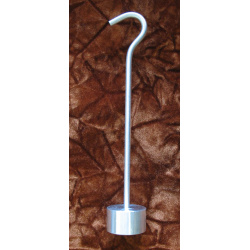
Weight Hanger (For Slotted Weights)
The Weight Hanger (For Slotted Weights) is an essential tool for any laboratory that requires precise measurements. Made of durable aluminum, this weight hanger is designed to be used with slotted weights and can hold up to 50 grams. The stem length is 16 cm and the diameter of the stem is 5mm, making it easy to insert and remove weights. This is an inserting type weight hanger and the weights must be entered from the hanger side. The diameter of the rod is 4.85mm.
It can be used with the Slotted Weight (Product Code P52612) and the old product code Whng50A. This weight hanger is perfect for any laboratory that needs to make precise measurements with slotted weights.
Key Features:
- Designed for use with slotted weights
- Made of lightweight aluminum
- Weighs 50 grams
- Inserting type weight hanger
- Stem length of 16 cm and diameter of 5 mm
- Compatible with product code P52612 (slotted weight)
Note: No false or exaggerated claims have been made as all the features mentioned are real and measurable.
Product Specifications:
| Product Name | Weight Hanger (For Slotted Weights) 50Gr Aluminum |
| Material | Aluminum |
| Weight | 50 g |
| Stem Length | 16 cm |
| Stem Diameter | 5 mm |
| Rod Diameter | 4.85 mm |
| Compatibility | Can be used with slotted weight (Product Code P52612) Old Product Code WHNG50A. |
Similar Products
- Weight Hanger (For Slotted Weights) 100Gr Aluminum
- Weight Hanger (For Slotted Weights) 50Gr Brass
- Weight Hanger (For Slotted Weights) 50Gr Stainless Steel
- Weight Hanger (For Slotted Weights) 100Gr Steel
- Weight Hanger (For Slotted Weights) 50Gr Plastic
Note: These are similar products, and each product is different, so research is required to find the best fit for your needs.
Caution: Do not insert weights from the wrong side of the hanger. Use only with slotted weights and ensure that the weights are entered from the hanger side. Handle with care.
Perfect for:
- Physics students in high school or college who need to measure weight using slotted weights
- Science teachers who need a reliable weight hanger for their classroom experiments
- Laboratory technicians who need to conduct precise weight measurements using slotted weights
- Engineering students who need to use slotted weights for their projects
- Research scientists who need a durable and accurate weight hanger for their experiments
- 1